A visit to the Hispanic Society Museum and Library was on the program of the 2025 conference of the Early Book Society but had to be cancelled because of a perfect storm of complications. In lieu of that visit, this video provides a wonderful survey of the Hispanic Society’s holdings and history. Find out even more at the Society’s website here.
Category Archives: Uncategorized
Courses at the London International Palaeography School
The London International Palaeography School is a series of intensive courses in Palaeography and Manuscript Studies.
The in-person Summer School runs annually at Senate House, London (this year from 9-13 June), while online courses run throughout the year. A limited number of bursaries are available.
In-person courses this year include a practice-based course on making medieval manuscripts, courses on Early Modern English palaeography, an introduction to writing in the early Frankish world, a course on illustrated manuscripts from Florence, and a week-long introduction to working with manuscripts. Online courses deal with medieval Latin, French, and Spanish palaeography, as well as manuscript layout.
A discount of 10% will apply to all Summer School bookings made before 4 January 2025. Please use the code LIPS10 at the checkout.
More information about the Summer School can be found here: https://ies.sas.ac.uk/london-international-palaeography-school
More information about online courses can be found here: https://ies.sas.ac.uk/london-international-palaeography-school/short-courses
News from Rare Book School
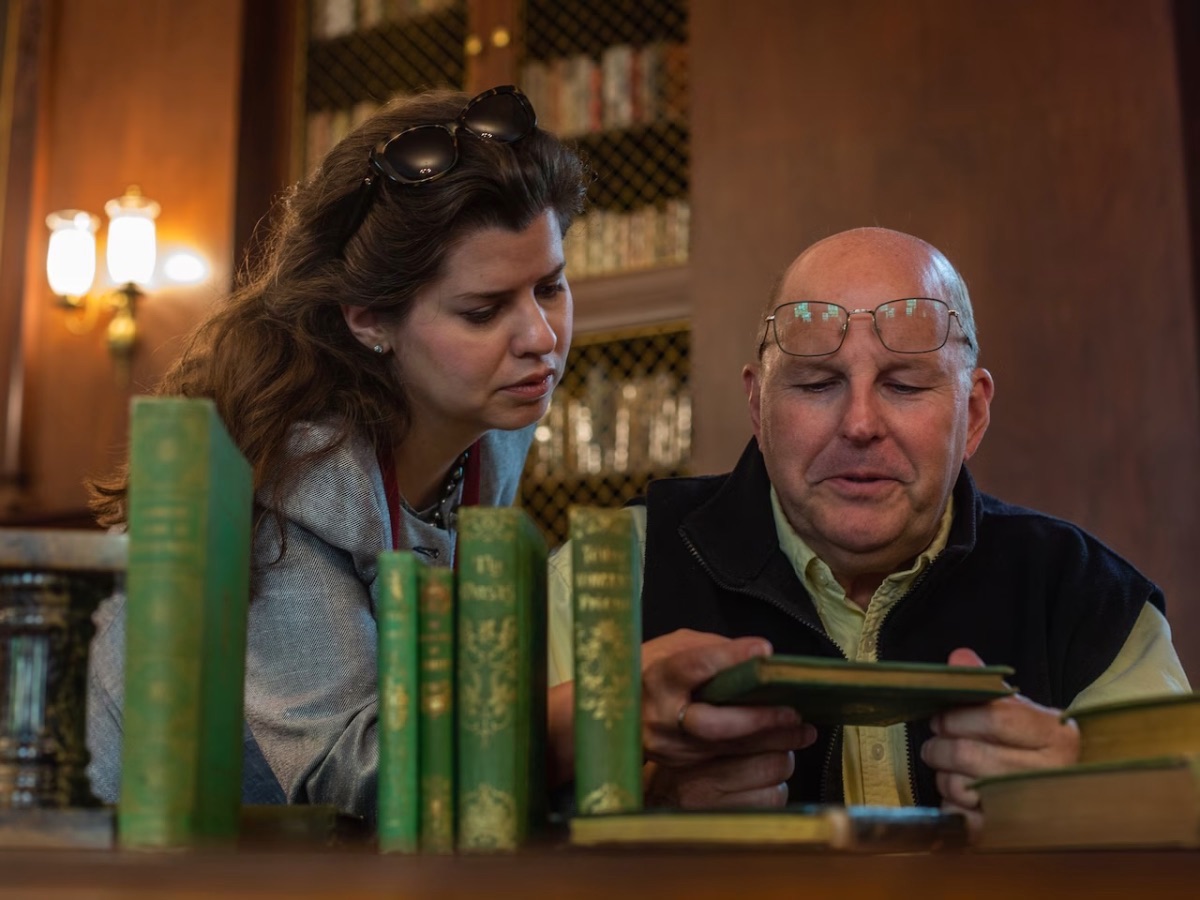
Rare Book School was recently featured in a Washington Post article about “poison books.” The story included pictures of RBS staff member Barbara Heritage and RBS faculty member Todd Pattison in UVA Shannon Library’s McGregor Room (affectionately known as the “Harry Potter Room,” right down the hall from our offices).
Pattison, who taught an RBS course on nineteenth-century American bookbindings in Charlottesville in mid-July, talked with the Post about his collection of rare books that contain arsenic. Students taking his course were able to see his “poison books” up close. According to Pattison, “We look at them differently and take special care, but it’s a great reminder we still have so much to learn about these cultural artifacts.”
Find more Rare Book School news here.
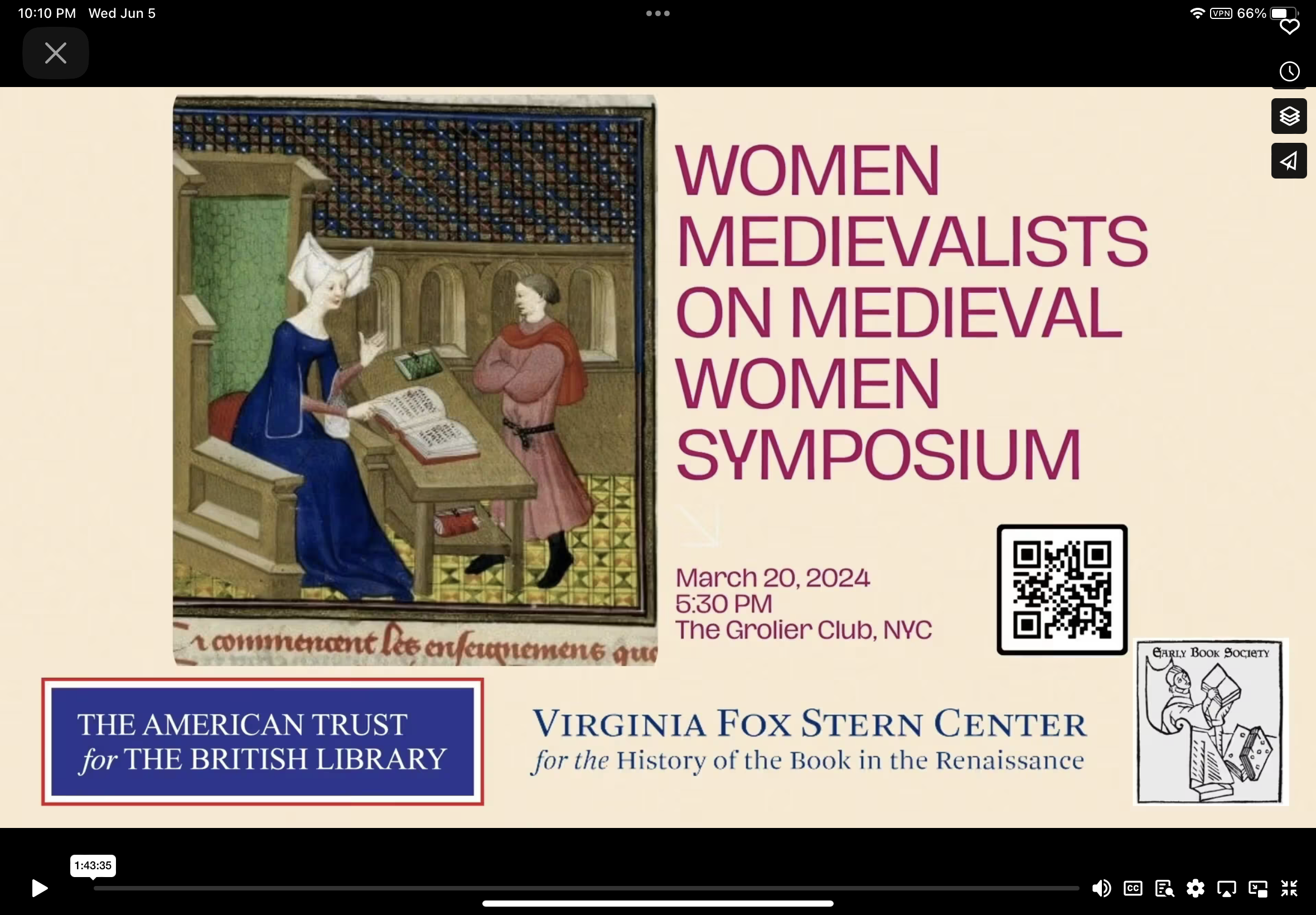
Video recording of ATBL Women Medievalists on Medieval Women Symposium
This symposium took place on March 20, 2024 and was announced at this site in this post here. Click on the image below to go to the recording.
The exhibition is written up in the events section of the spring newsletter. October 25–March 2, 2025 Medieval Women: In Their Own Words, an exhibition at the British Library, London, curated by Ellie Jackson and Julian Harrison, and supported by Joanna and Graham Barker, which highlights women’s achievements and contributions to the arts, healthcare, and society, among other themes, between 1100 and 1500. See https://blogs.bl.uk/digitisedmanuscripts/2024/03/exhibition-on-medieval-30 women.html.
Peter Selly Fellowship
The Peter Selley Fellowship for Members of the Book Trades at the Bodleian Libraries is open to applicants pursuing a career in book or MS auctions or the antiquarian book trade. The Fellowship honors the memory of Peter Selley, a rare book specialist and auctioneer who worked at Sotheby’s in London for 28 years who died in 2021 and provides support for the successful applicant to carry out research in the special collections of the Bodleian Libraries. Peter Kidd was the first fellow in 2023/24, researching ‘The Illuminated Cuttings of William Young Ottley.’
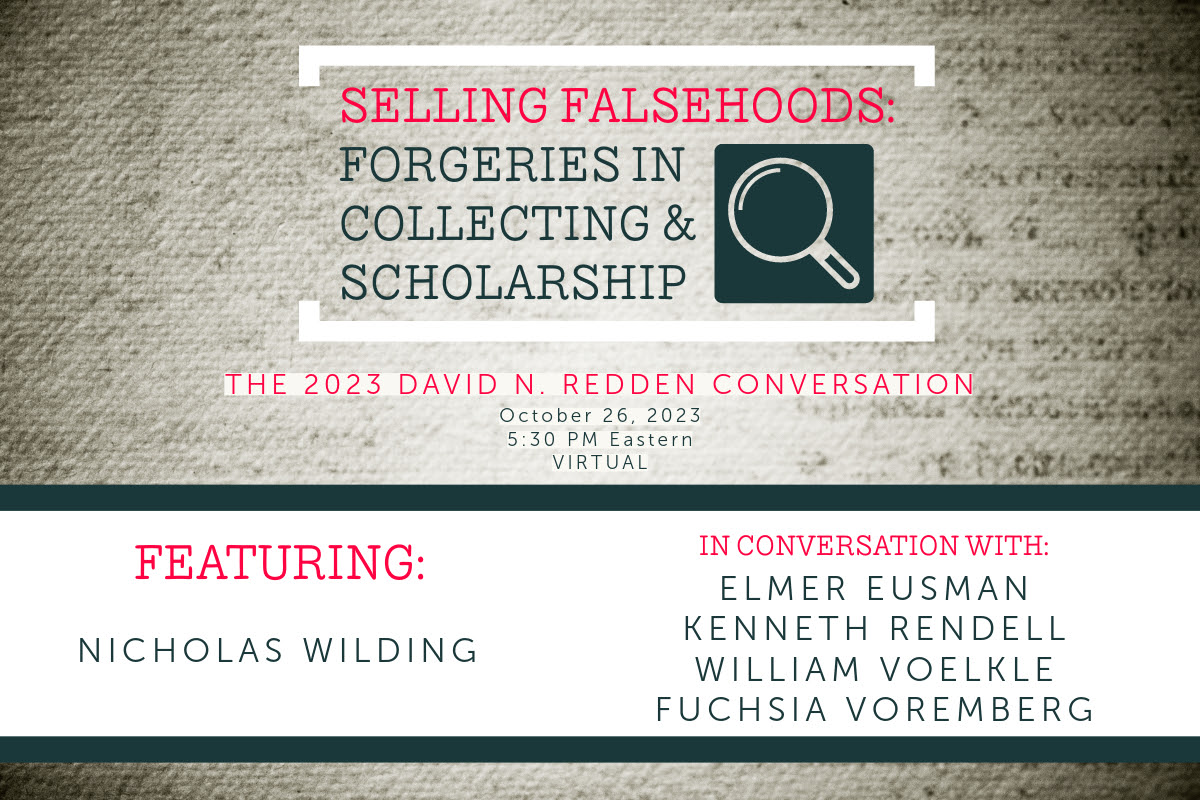
The 2023 David N. Redden Conversation ~
The American Friends of the British Library presents …
Update: EBS at Kalamazoo 2021
While nearly all speakers scheduled for May 2020, the cancelled conference, have said they wish to return in May 2021, there are still spaces available. The EBS sessions for 2021 are the same as for 2020. These are listed below. We will also have to see what happens with international travel before May 2021, but all previously accepted speakers are encouraged to reapply. All previously accepted speakers must reapply through the portal. Please see the instructions here: https://wmich.edu/medievalcongress/submissions
The sessions needing more papers are Copying, Editing and Correction, and What makes an English Book English? If there is another session that interests you, you might submit an abstract and see what happens.
‘What’s Past Is Prologue’: Transition of Literary Works from MS to Print
Presider: Patricia Stoop, University of Antwerp
“Translating the Past: Antonio de Nebrija Rewrites the Catholic Monarchs”
— Bretton Rodriguez, University of Nevada, Reno
“An Early Modern/Medieval Book”
— Catherine E. Corder, University of Texas—Arlington
“Printing the Past? Seeking ‘Authenticity’ in an Icelandic Proverb Collection”
— Christine Schott, Erskine College
Bi- and Tri-Lingual Manuscripts and Early Printed Books
Presider: Martha W. Driver
“English Women’s Bilingual Manuscripts: Latin AND (not OR) the Vernacular”
— Caitlin Branum Thrash, University of Tennessee, Knoxville
“Multi-lingual Apocalypses in Late Medieval England”
— Karen Gross, Lewis & Clark College
“‘Bremschet Scripcit’- A Multilingual Female(?) Annotator of Stephen Scrope’s Letter of Othea”
— Sarah Wilma Watson, Haverford College
Migrating Manuscripts and Peripatetic Texts
Presider: Sarah Wilma Watson
“Travelling scholars and manuscripts: the influence of the Paris university book trade on English intellectual life and visual art”
— Alison Ray, Canterbury Cathedral Archives and Library
“Total Oblivion? Wycliffite Gospel Commentaries and their Textual Afterlives”
— David Lavinsky, Yeshiva College, Yeshiva University
“Short Migrations with Long Consequences: Loan Chests and Book Movement in Late Medieval Oxford”
— Jenny Adams, University of Massachusetts—Amherst
Visual and Verbal Portraits in Manuscripts and Printed Books
Presider: Jill C. Havens, Texas-Christian University
“Imagining the ‘Best Knight’ in the World: Sir Lancelot in the Old French Vulgate and in the Images of the Yale 229 Lancelot Codex”
— Elizabeth Willingham, Baylor University
“Jean de Vignay at the Heart of the Early Valois Court: The Portrait of the Translator in the Jeu des échecs moralisé (Morgan G. 52)”
— Lisa Daugherty Iacobellis, Special Collections, The Ohio State University Libraries
“‘Marie our Maistresse’: A Verbal Portrait of Queen Mary I at her Accession”
— Valerie Schutte, independent scholar
“‘A Knyght ther was, and that a noble man’: The Knight’s portrait in Caxton’s illustrated edition of the Canterbury Tales 1483″
— Anamaria Ramona Gellert
Copying, Editing and Correction: How Accurate Is It?
Presider: S. C. Kaplan, Rice University
“Remaking Old Texts New Again”
— Lori Jones, Carleton University, University of Ottawa
“Multiple Copies, One Source? 15c Redactions of John of Tynemouth’s Sanctilogium in Cotton, Tiberius E. I”
— Virginia Blanton, University of Missouri-Kansas City
What Makes an English Book English?
Presider: Neil B. Weijer, George A. Smathers Libraries, University of Florida
“Decorating to Anglicize the Book”
— J. R. Mattison, University of Toronto
“A Greek Lectionary in New Zealand”
— Alexandra Gillespie, University of Toronto
Whittington’s Gift: Reconstructing the Lost Common Library of London’s Guildhall
This three-year project, led by Dr Ryan Perry at the University of Kent and Dr Stephen Kelly at Queen’s University Belfast, has been funded by the Leverhulme Trust (£367,000) and will appoint two postdoctoral research assistants, one to be located at each institution.
On the project: Whittington’s Gift aims to demonstrate that London citizens created new programmes of religious education for both the City’s clergy and for literate lay communities that have hitherto gone largely unnoticed by scholarship. Thanks to the legacy of Richard Whittington (d. 1423), perhaps London’s most storied mayor, an extraordinary resource for religious education emerged under the auspices of Whittington’s innovative executor, John Carpenter, common clerk of London’s Guildhall. By tracking the transmission of texts that the applicants contend were sourced from the Guildhall Library, we aim to radically complicate understanding of fifteenth century literary culture in the capital and beyond.
Candidates must have excellent palaeographical and codicological skills, and have a research focus on fourteenth and fifteenth century English devotional literature and culture.
The PDRA based at Kent will work closely with Dr Ryan Perry on the codicological assessment of the project’s corpus, with a view to identifying codices the project team believe were either produced or copied from exemplars originally held at the London Guildhall Library.
The PDRA based at Queen’s will have responsibility for producing diplomatic transcriptions of the project’s textual corpus, for inclusion in one of the project’s main outputs, Meke Reverence and Devocyon: A Research Anthology of Late Medieval English Religious Writing (the first since Hortsmann in the 19th century). Familiarity with the protocols of contemporary textual scholarship will be a benefit.
It is hoped that posts will be advertised in the summer with the PDRAs hopefully commencing in late September (current circumstances allowing).
The Early Book Society at Kalamazoo 2020
EBS has six sessions to fill for Kalamazoo 2020 (May 7 to 10). Please send abstracts by Sept 15 or before, along with any a-v requirements you might have. Please send to Martha Driver at mdriver@pace.edu with Kazoo 2020, your surname and the session in which you wish to participate in the subject line. See also below.
The sessions are these:
Bi- and Tri-Lingual Manuscripts and Early Printed Books
Copying, Editing and Correction: How Accurate Is It? (1 accepted)
Visual and Verbal Portraits in Manuscripts and Printed Books (1 accepted)
Migrating Manuscripts and Peripatetic Texts
“What’s Past Is Prologue”: The Transition of Literary Works from Manuscript to Print
What Makes an English Book English?
Contact:
Martha W. Driver
Pace Univ. Dept. of English
41 Park Row New York, NY 10038
Phone: (212) 346-1676 Fax: (212) 346-1754
Email: mdriver@pace.edu
Each speaker must include a Participation Information Form with an abstract, which are available at https://wmich.edu/medievalcongress/submissions.
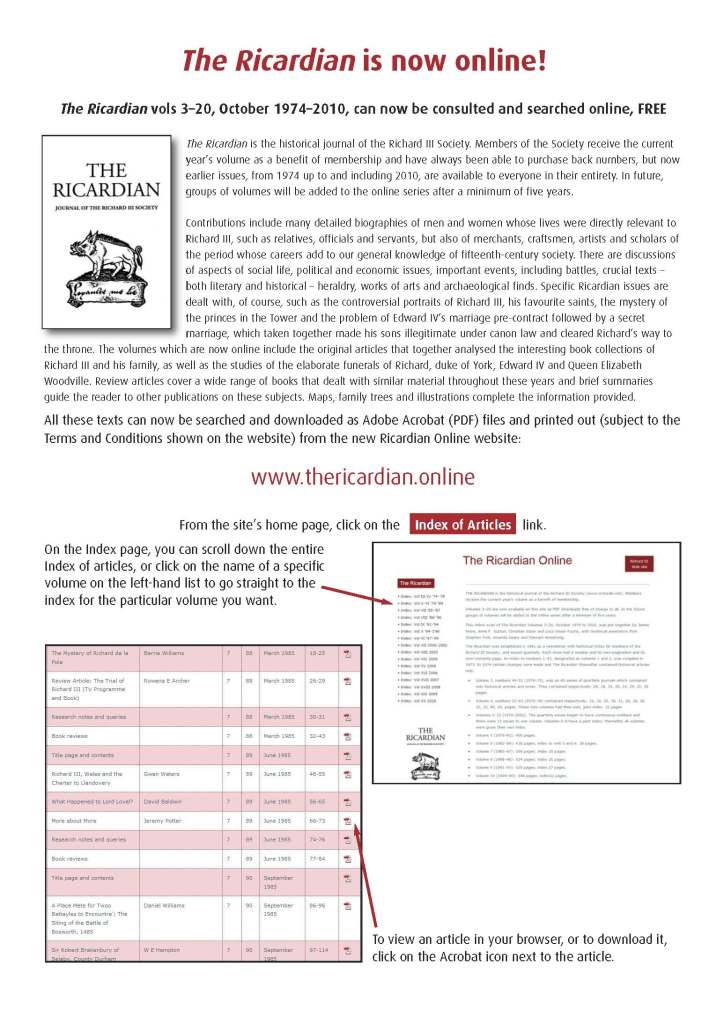
The Ricardian, now online
 Early Book Society